
5-Inch vs. 6-Inch Gutters: Which One Does Your Home Need?
The right size depends on your roof — not guesswork. Answer 4 quick questions below and get an instant recommendation.
5000+
Projects completed
100%
Seamless installation
Same week
Scheduling available
Free
On-site inspection

What's Actually Different Between 5 Inch and 6 Inch Gutters
Both 5-inch and 6-inch gutters do the same basic job: catch rain off your roof and send it away from your house. The difference is how much water each one can handle before it overflows.
| 5-Inch Gutters | 6-Inch Gutters | |
|---|---|---|
| Water capacity | Good for smaller, simpler roofs | ~40% more capacity than 5-inch |
| Best paired with | 2×3 downspouts | 3×4 downspouts |
| Typical home fit | Smaller, single-story homes under ~2,000 sq ft of roof, gentle slope | Larger or multi-story homes, steeper roofs, larger shingles |
| Look | Slightly slimmer profile | Slightly more visible, still clean-lined |
| Cost | Lower material cost | Slightly higher, but fewer overflow issues |
Both sizes are available in the same seamless aluminum material we install on every job — the size just changes how much water the system can move.

Why Your Roof Size Matters
Think of your roof as a giant funnel. The bigger the roof, the more rain it collects and sends down into your gutters during a storm. A small roof sends a trickle. A big roof sends a lot more, all at once.
Rule of thumb
Roofs under about 2,000 sq ft generate a manageable amount of water for 5-inch gutters. Larger roofs — and especially homes with multiple floors — send down a lot more water at once, which is when you start seeing water spill over the front edge instead of draining through the downspout. More floors also means more roof surface feeding into the same gutter run, which pushes toward 6-inch on its own, even before you factor in slope.
Not sure which option fits your home?
We’ll take a look at your roofline and give you an honest read on what makes sense — DIY-friendly or not.
Why Your Roof Slope Matters
A steep roof doesn’t just look dramatic — it makes water move faster. On a steep slope, rain picks up speed on the way down and hits the gutter harder and faster than it would on a flatter roof.
Rule of thumb
A flat or gently sloped roof gives water more time to drain calmly, so a 5-inch gutter can usually keep up. A steep roof sends water down fast and hard, which is exactly the kind of sudden rush that overwhelms a smaller gutter — even on a roof that isn’t especially large.
Frequently Asked Questions About Gutter Size
You can, and it’s rarely a bad choice — but on a small, gently sloped roof it can be an unnecessary added cost. Matching the size to your actual roof is usually the smarter move.
There’s a modest cost difference in material, but it’s usually small compared to the cost of repairing overflow damage from an undersized system.
Yes, though it usually means replacing the whole gutter run rather than just swapping a section, since hangers and downspout sizes change too.
No — it’s a starting point to help you understand the “why” behind gutter sizing. We always confirm the final recommendation with a real look at your roof before installing anything.
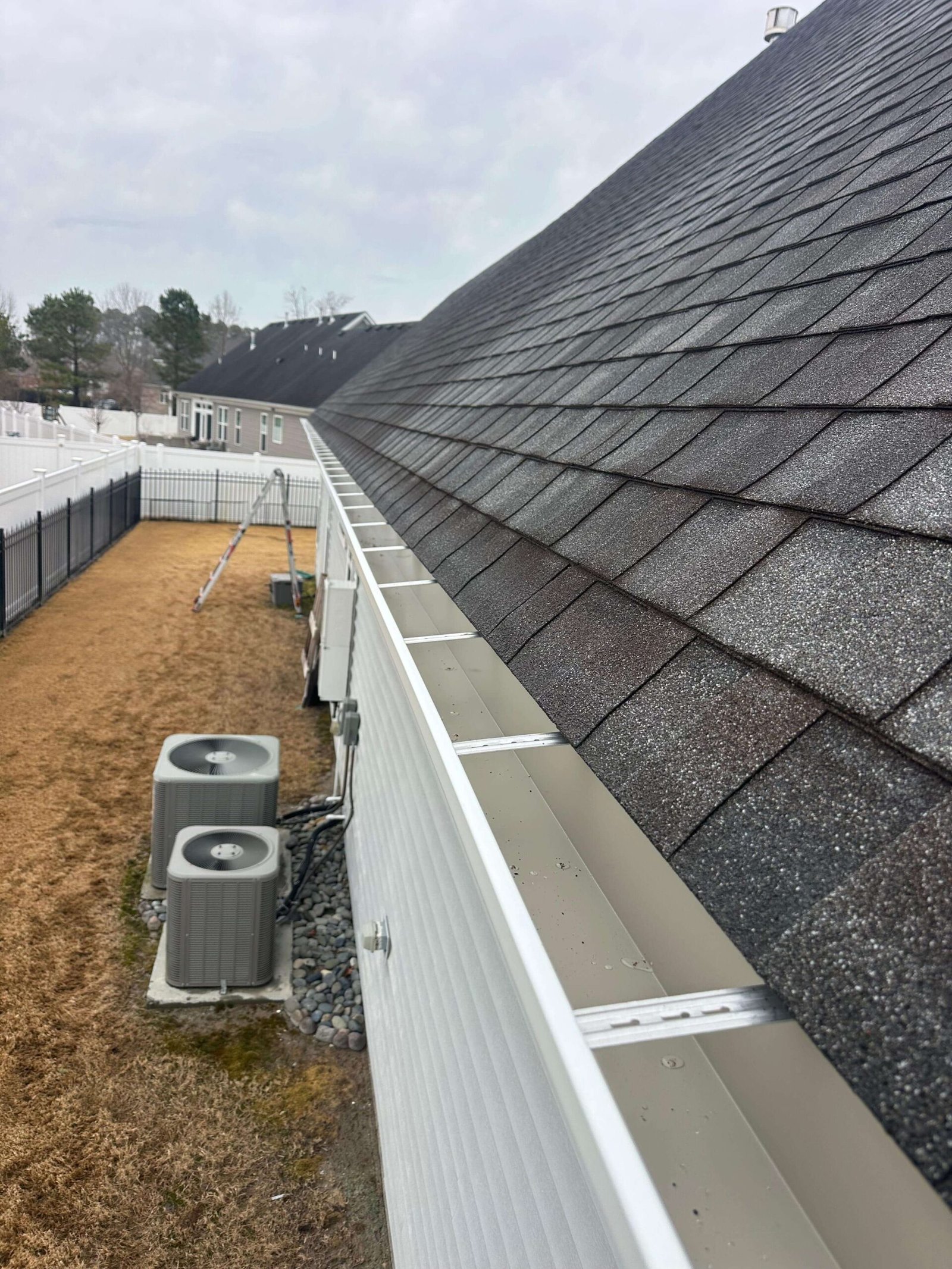
Why Shingle Size & Roof Overhang Matter
This one’s less obvious, but it’s one of the biggest factors our installers actually check on-site. It’s not just about what your shingles are made of — it’s about how big they are and how far they hang out past your fascia board (the wood trim your gutter is attached to).
Rule of thumb
Standard-size shingles that sit close to the fascia don’t give water much room to go anywhere but straight into the gutter — a 5-inch system can usually catch that fine. But when the shingles are larger and there’s a bigger gap between the fascia and the edge of the shingle, water has more distance to fall before it lands. That extra drop means it spreads out wider and lands with more force by the time it reaches the gutter — which is exactly the situation a 6-inch gutter is built to catch reliably.
This is one of those details that’s hard to judge from the ground, which is a big part of why we always confirm it in person rather than guessing from a photo.
Take the Quiz: Which Size Fits Your Home?
Answer these 4 quick questions. We’ll factor in Hampton Roads’ rainfall automatically.
🧮 Gutter Size Finder
Takes about 30 seconds — no email required to see your result.
Want us to confirm this and call you back?
We'll call to confirm your size and answer any questions. No spam, ever.
whichever size fits, it’s backed by our 20-year warranty
Still Not Sure? Here's What We'd Do
Honestly, most homeowners can’t tell their exact roof slope or square footage off the top of their head, and that’s completely normal. If your quiz result comes back “borderline,” or you just want to be certain before spending money on either size, the fastest way to know for sure is a quick, free site visit.
We’ll walk your roofline, measure what actually matters, and tell you straight 5-inch or 6-inch, with a clear reason why. No pressure, no upsell, just the size that’s actually right for your home.
Get a Free Gutter Inspection
Not sure if DIY or professional installation is right for your home? We’ll give you an honest read, free of charge.
Ready to Get the Right Size, Guaranteed?
Book a free site visit and we’ll confirm exactly what your home needs — no guesswork, no upsell.
Serving Hampton, Newport News, Norfolk, Virginia Beach, Chesapeake, Suffolk, Portsmouth, Williamsburg, York County, Poquoson & Gloucester.