
Gutter Tips
Custom Seamless Gutters: Why On-Site Fabrication Fits Coastal Homes Better
Near the coast, a gutter’s fit can make all the difference: it may shed a hurricane, or let water blow in sideways instead.

What "On-Site Fabrication" Actually Means
Stock sectional gutters come pre-cut in standard lengths, usually about 10 feet. You trim them and join the pieces with connectors at home. Custom gutters are made on-site instead. A technician brings a roll-forming machine and shapes flat aluminum coil into one continuous run, cut to fit your roofline exactly.
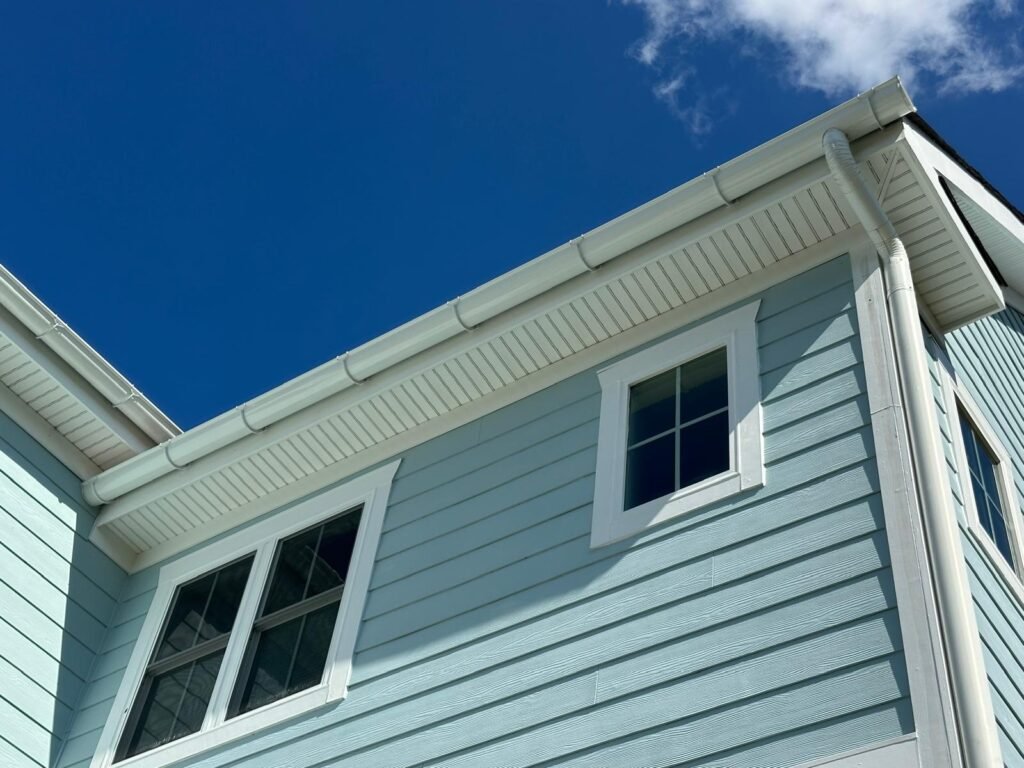
The only joints are at corners and downspout outlets. Everywhere else, the gutter is one unbroken piece. That is the mechanical reason custom seamless gutters outperform stock systems, and it’s worth knowing before getting into why the difference matters more here than in most places.
Frequently Asked Questions About Custom Gutters
A technician brings a roll-forming machine to your home and shapes aluminum coil into a gutter custom-length to match your roofline exactly, rather than installing pre-cut stock sections.
Wind-driven rain during coastal storms can push water sideways into gaps that ordinary vertical rain would never reach, and salt-laden air accelerates corrosion at every joint. Fewer, tighter joints mean fewer places for either to get in.
Typically a bit more upfront, but the reduced leak risk and longer lifespan usually make up the difference well before the gutters need replacing.
Yes – that’s actually where on-site fabrication has the biggest advantage, since each run is shaped to the specific roofline in front of the installer, not a standard pre-cut length.
The fabrication itself happens in minutes per run, since the machine forms continuous lengths on demand. Full installation for an average home typically takes a few hours.
Why Fit Matters More Near the Coast
A slightly uneven seam is a small concern on a calm, dry day in most places. Along the coast, three things can turn it into a real problem.
Wind-Driven Rain Finds Every Gap
Coastal storms don’t send rain straight down. Wind can shove it sideways, hard enough to push water into gaps ordinary rain won’t reach. A custom-fit seam, with snug corners, leaves that wind little to work with.
Salt Air Attacks Joints First
Corrosion doesn’t spread evenly along a gutter. It starts where moisture can sit and metal edges meet. Each extra joint in a sectional system gives it another place to start. Fewer joints mean fewer spots where salt air can get the process going.
Coastal Temperature Swings Test Every Seam
Aluminum expands and contracts as temperatures change. Hampton Roads gets real shifts, from humid summer heat to winter cold snaps. A custom run made for the exact roofline, with room to expand at the right points, handles those changes more predictably than a row of connector joints.

Custom Rain Gutters vs. Stock Sectional Systems
Here’s how the five most common gutter materials stack up for coastal Virginia conditions specifically:
| Stock Sectional | Custom Seamless | |
|---|---|---|
| How it’s made | Pre-cut lengths, trimmed and joined on-site | Formed on-site to the exact roofline measurement |
| Joint count on a typical run | Multiple connector joints every 10 feet | Joints only at corners and downspouts |
| Wind-driven rain resistance | Each joint is a potential entry point | Far fewer entry points along the run |
| Fit on irregular rooflines | Compromise cuts and extra seams at odd angles | Shaped to the actual roofline in front of the installer |
How We Fabricate Custom Gutters On-Site
See the full process on our gutter installation and replacement page, or check pricing on our gutter cost guide.
1
Measure the actual roofline
Every run, corner, and downspout location gets measured on-site, not estimated from a standard chart.
2
Form the coil to length
The roll-forming machine shapes aluminum coil into a continuous run matched exactly to that measurement.
3
Mount with hidden hangers
Spaced and secured to hold through coastal wind, not just calm weather.
4
Set the slope
Calibrated to the specific roofline in front of us, so water reaches the downspout instead of pooling.
Do Custom Seamless Gutters Cost More?
Usually a bit more upfront than stock sectional systems, but the comparison isn’t really about sticker price. Fewer joints mean fewer future leak repairs, less fascia damage from slow drips nobody notices, and a system that holds up longer before replacement. Over the life of the gutter, the gap narrows considerably. For real numbers, see our full breakdown of seamless gutter value.
Choosing the Right Fit for Your Coastal Home
Custom seamless gutters are especially worth prioritizing if:
- Your home is within a few miles of the coast or a large body of water
- Your roofline has corners, dormers, or more than one roof type
- You've had leaks at joints on a previous sectional system
- You want a system that holds up through hurricane season, not just calm weather
Material still matters too — see our gutter material guide for coastal Virginia for the full aluminum-vs-copper-vs-steel comparison, and our 5-inch vs. 6-inch quiz if you’re not sure which size fits your roof.
See What a Custom Fit Looks Like on Your Home
Free inspection, exact measurements, and a 20-year transferable warranty on every custom installation.
Serving Hampton, Newport News, Norfolk, Virginia Beach, Chesapeake, Suffolk, Portsmouth, Williamsburg, York County, Poquoson & Gloucester.
Get a Free Gutter Inspection
Not sure if DIY or professional installation is right for your home? We’ll give you an honest read, free of charge.